06 · Technology · Term 1
Thumbprint and Spinner
a surface to touch
Two Grasshopper exercises in generative and parametric geometry
Two Freshmore computational design exercises: a rotationally generated line figure after a fidget spinner, and a scripted thumbprint tile taken through to 3D print.
Two assignments from the Freshmore computational design sequence, both produced in Rhino 7 with Grasshopper. The decks record a first encounter with the software: the brief was to work from taught templates and the course GitBook toward a piece of geometry of the student's own choosing. The two submissions are set out in parallel, one generative and one parametric, and together they trace a move from assembling components to writing the equation that drives them.
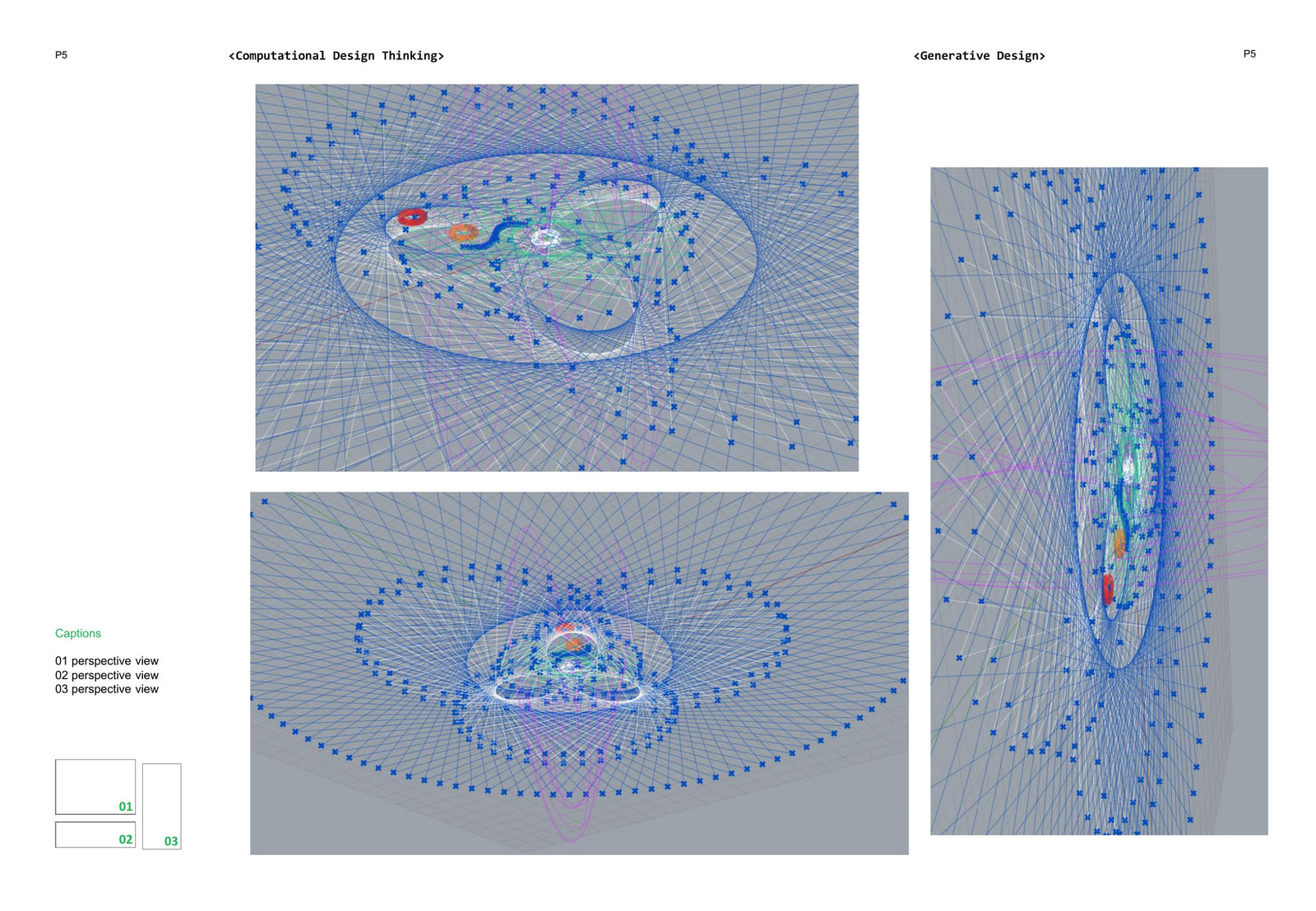
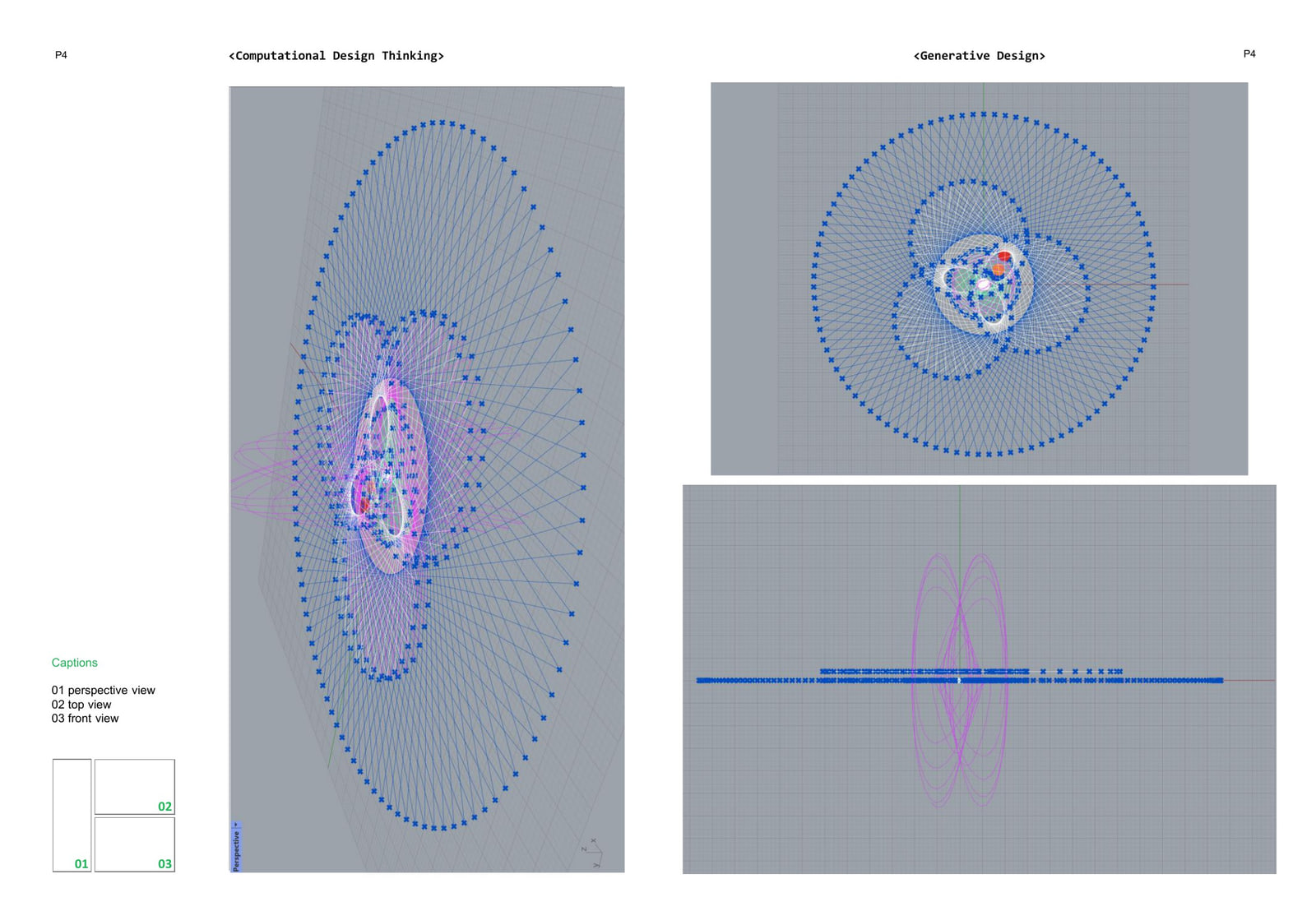
The first exercise, Generative Design, takes the fidget spinner as its motif. A Series component is divided and passed through sine and cosine to construct points, which are then rotated into circular arrays; number sliders for count, radius, cycles and phase control how far the resulting lines splay. Expression components applied to the x, y and z coordinates warp the arrays out of plane, so that the flat spinner silhouette at the centre sits inside a much larger conical field of blue radial lines and cross-marks. Read from above it resolves into a three-lobed spinner; in perspective it is closer to an orbital diagram than a toy.
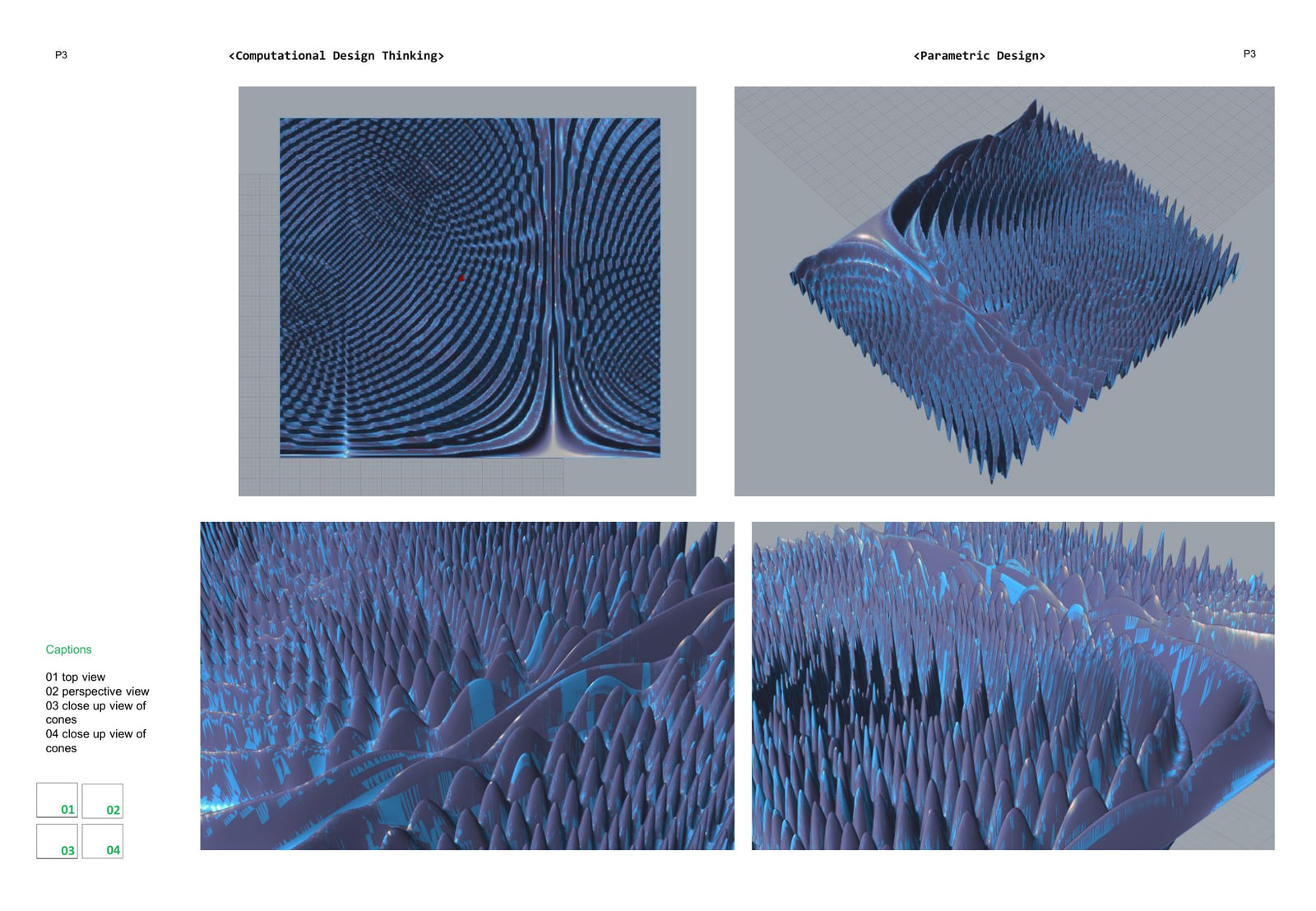
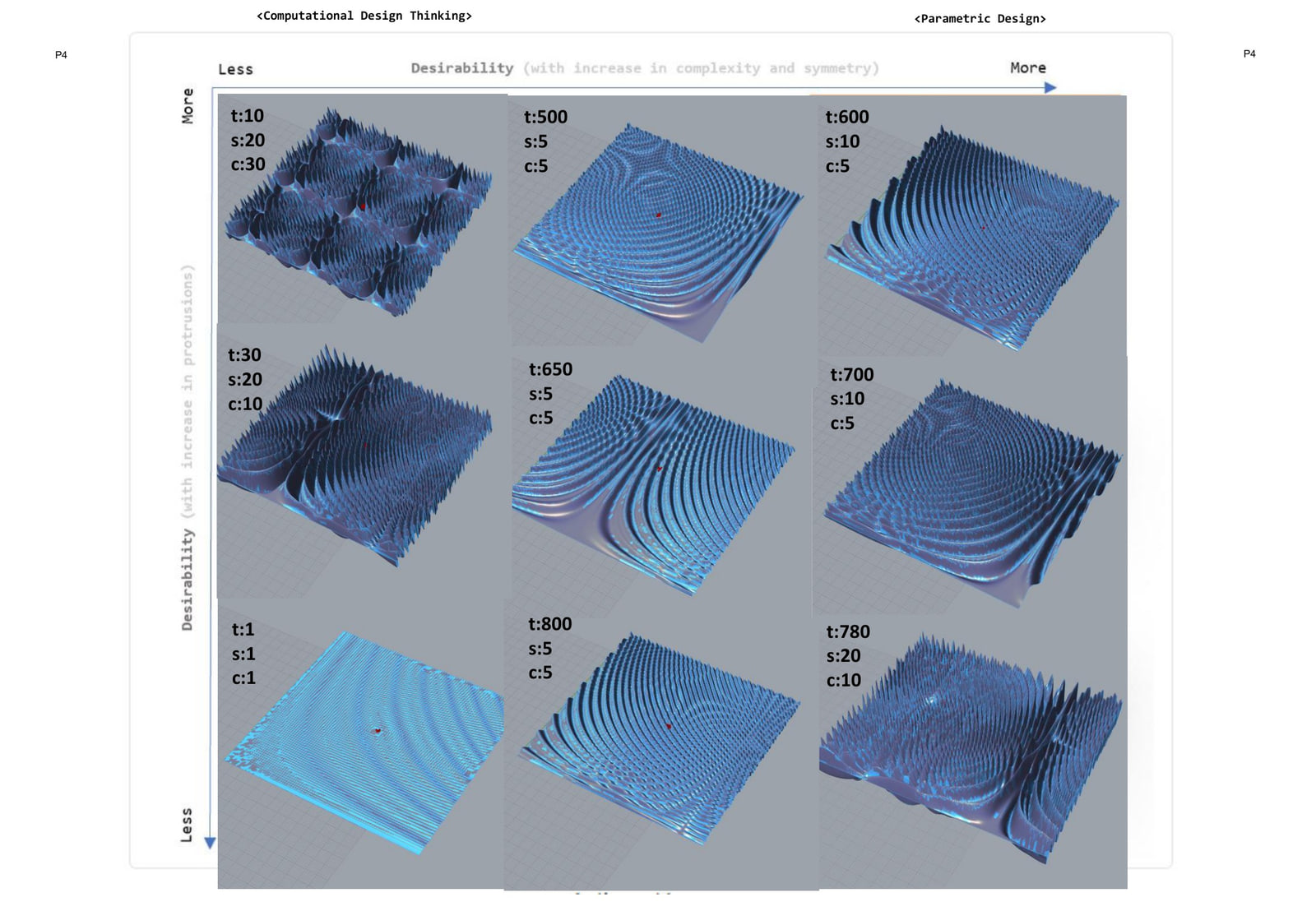
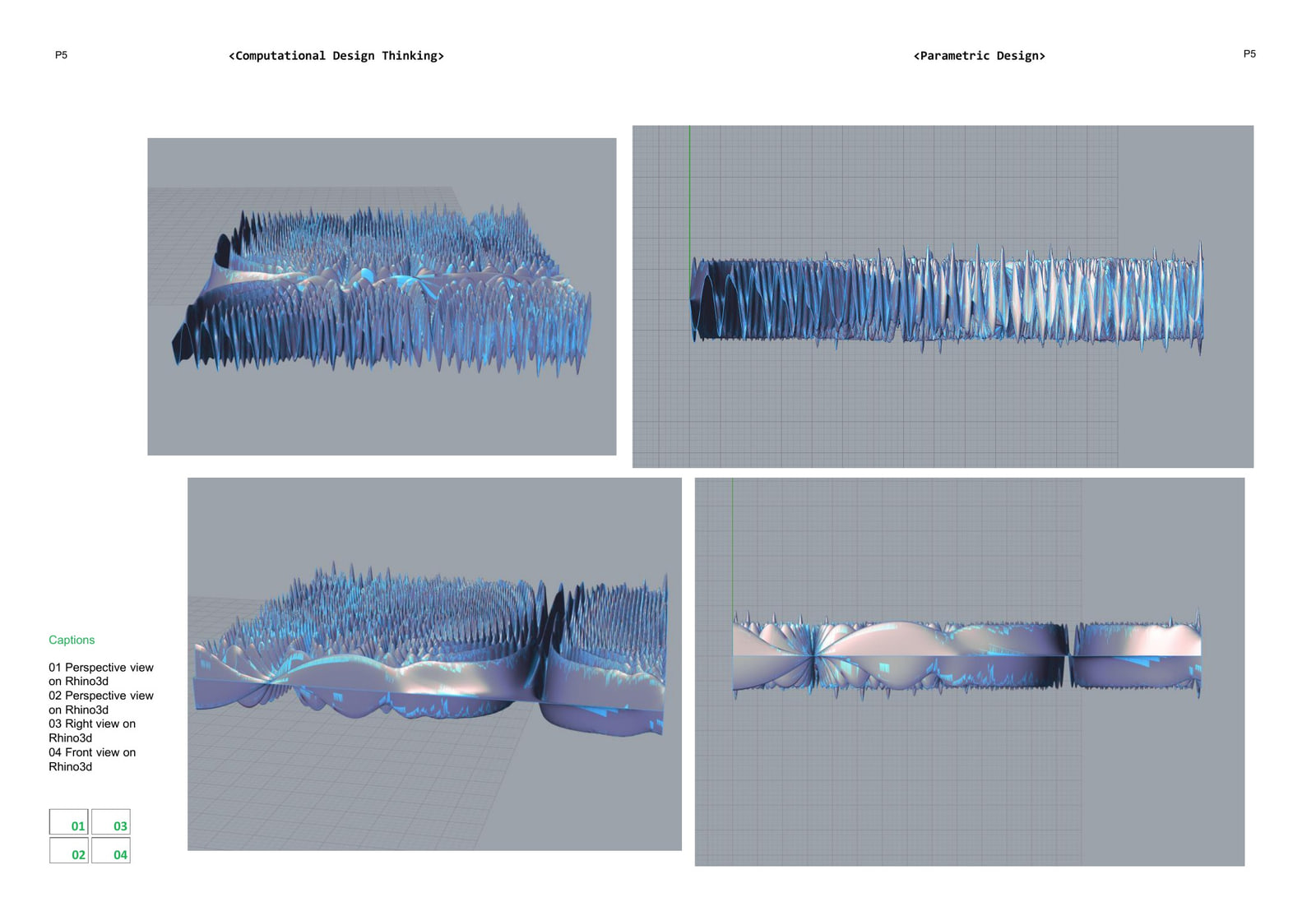
The second exercise, Parametric Design, replaces component assembly with a single line of GhPython. A 95 by 85 point grid is deconstructed and each point's x and y fed into a script that returns z as the product of five trigonometric terms — sine, cosine, sine, cosine and tangent of c·pi·((x−t)/32)·(y/32), scaled by s. The output is interpolated into a surface and meshed. The three sliders behave as a small design space: the deck documents nine states of t, s and c, from a coarse corduroy ripple to a dense field of needles, before settling on t 784.345, s −19.472 and c 10.0. At that setting the surface reads as a thumbprint, concentric ridges breaking around a delta, rendered through a graded colour swatch that stands in for the unevenness of ink.
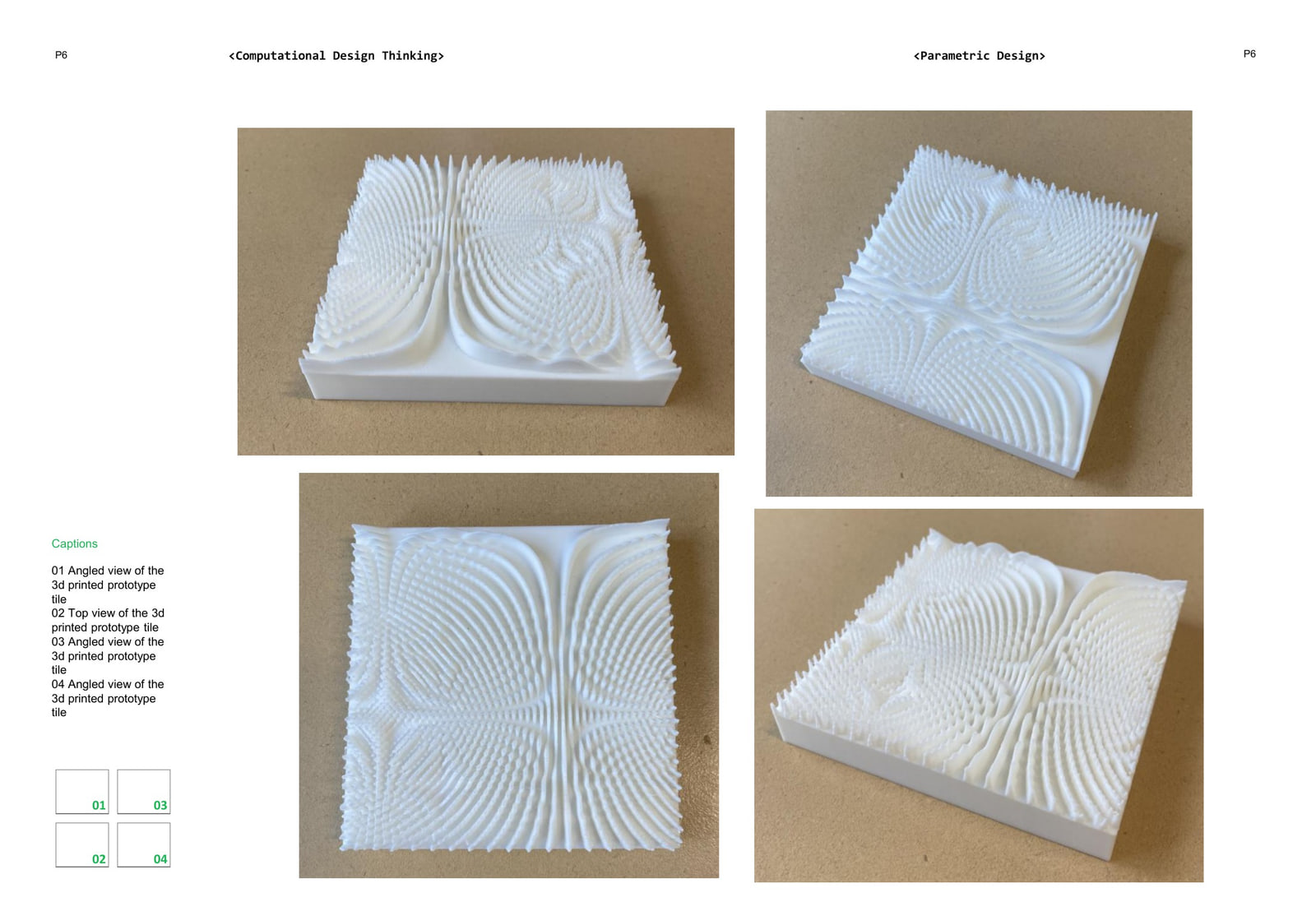
The tile was then 3D printed in white filament on a flat base, roughly the size of a coaster. The print is the more telling document of the two projects: at that resolution the mathematical surface becomes a bristle of individual spines, and the ridge-and-furrow pattern that was legible as an image on screen only partly survives translation into material. The photographs on the last page, taken on a desk, are where the exercise stops being a screen study.