03 · Fabrication · Term 4
Contrary Bloom
a place to gather in shade
A hand-cranked bamboo parasol that opens like an anemone
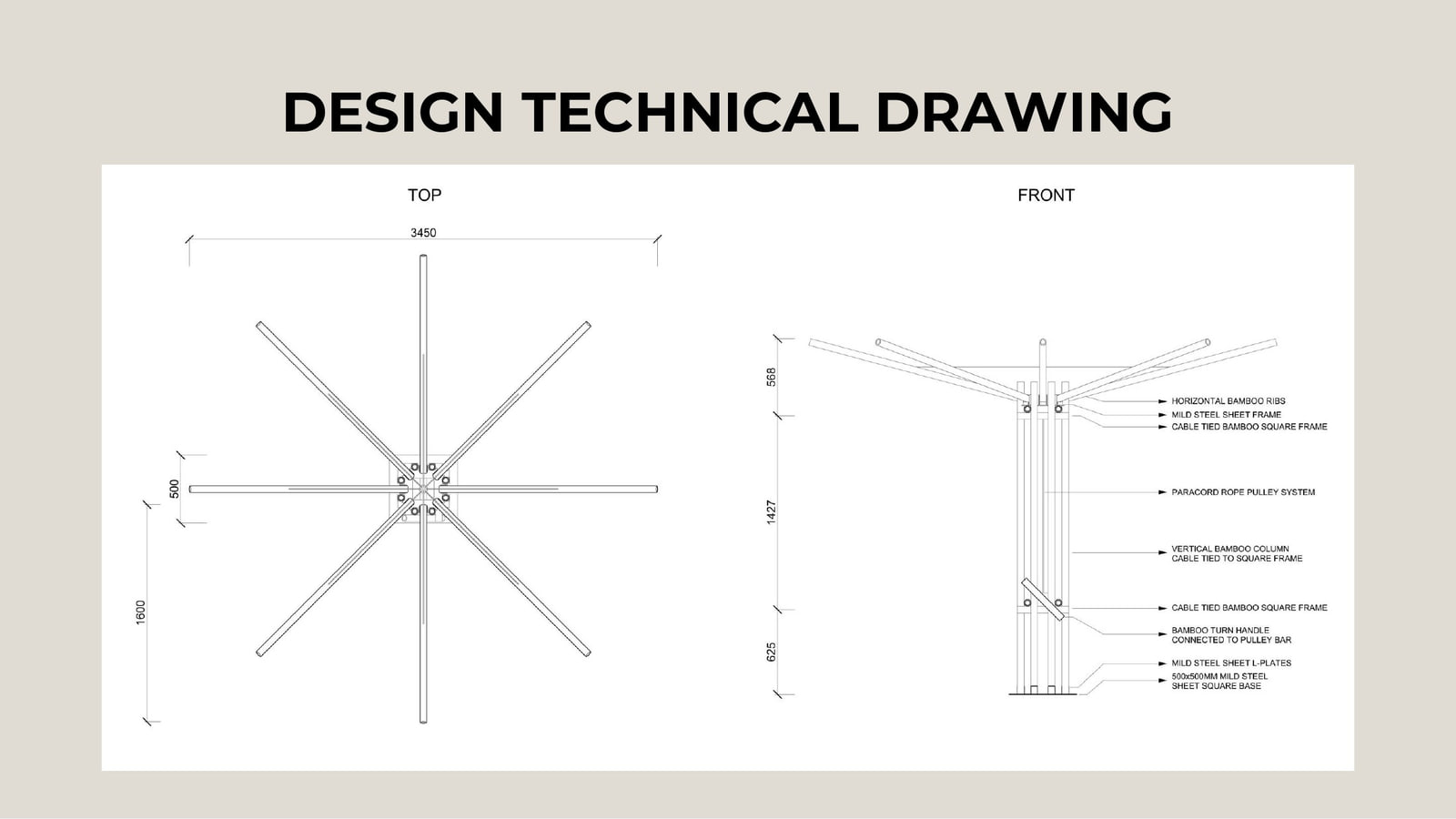
A 3.45-metre deployable bamboo parasol: a hand crank spools paracord through a 3D-printed hub, drawing eight ribs open on a laser-cut steel crown.
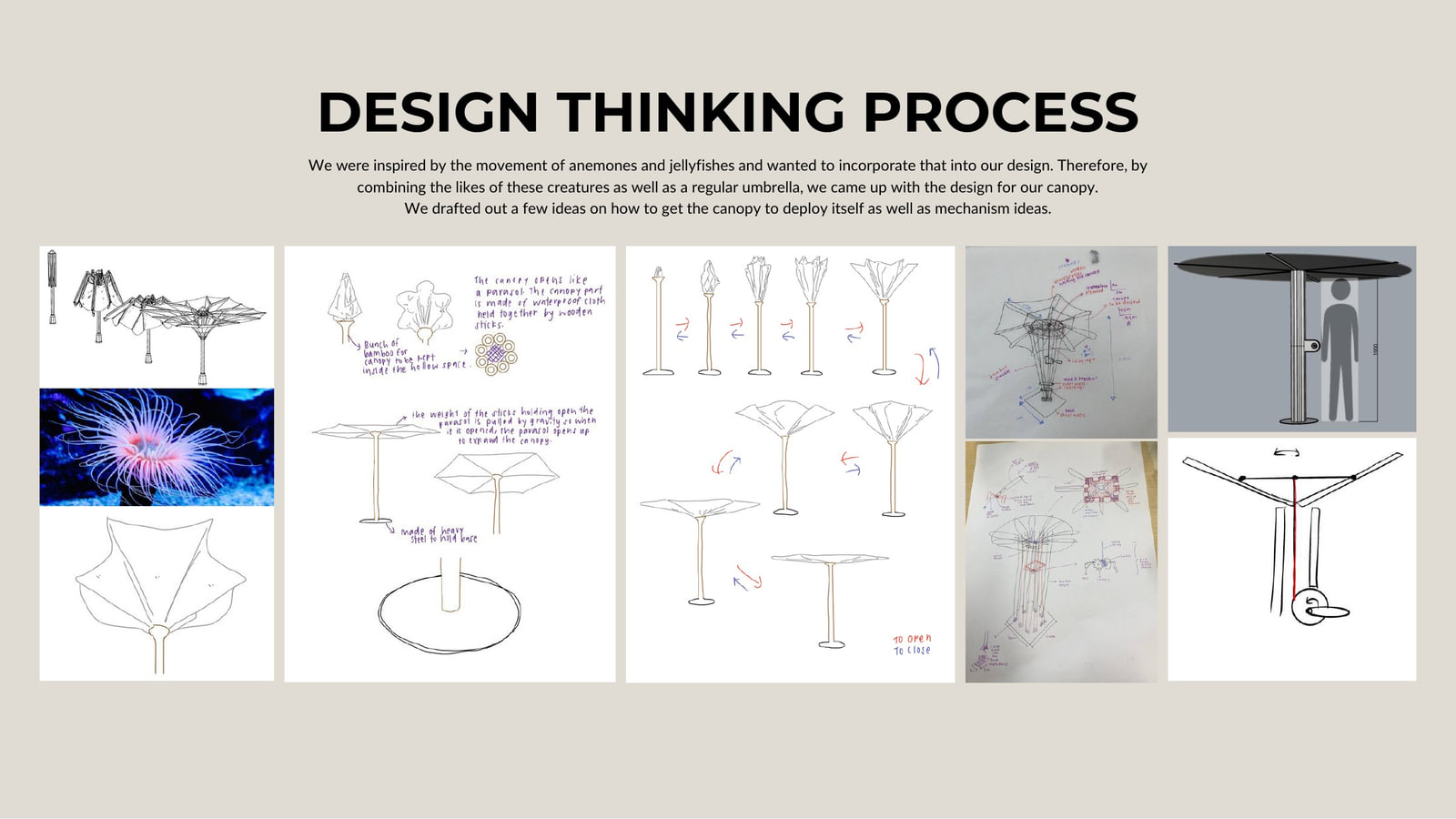
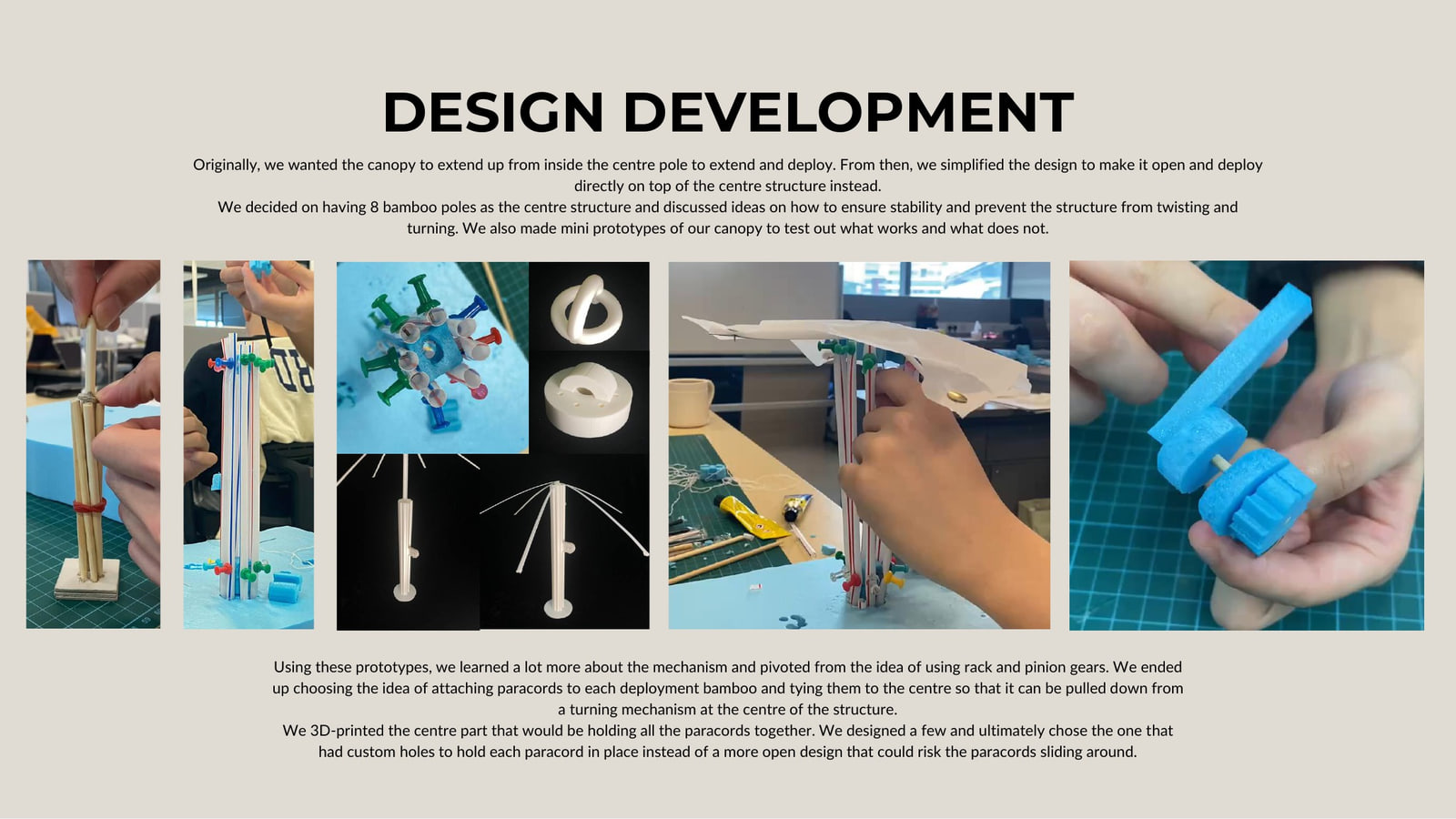
The final piece for Design and Digital Fabrication, filed as a joint DDF and ASE submission and built by a team of five in the SUTD FabLab. The group began from the movement of sea anemones and jellyfish — a radial body that opens and closes on itself — and crossed it with the ordinary umbrella. Early schemes had the canopy telescoping up out of the central pole; that was abandoned for something simpler, a canopy that sits on top of the mast and blooms upward from it.
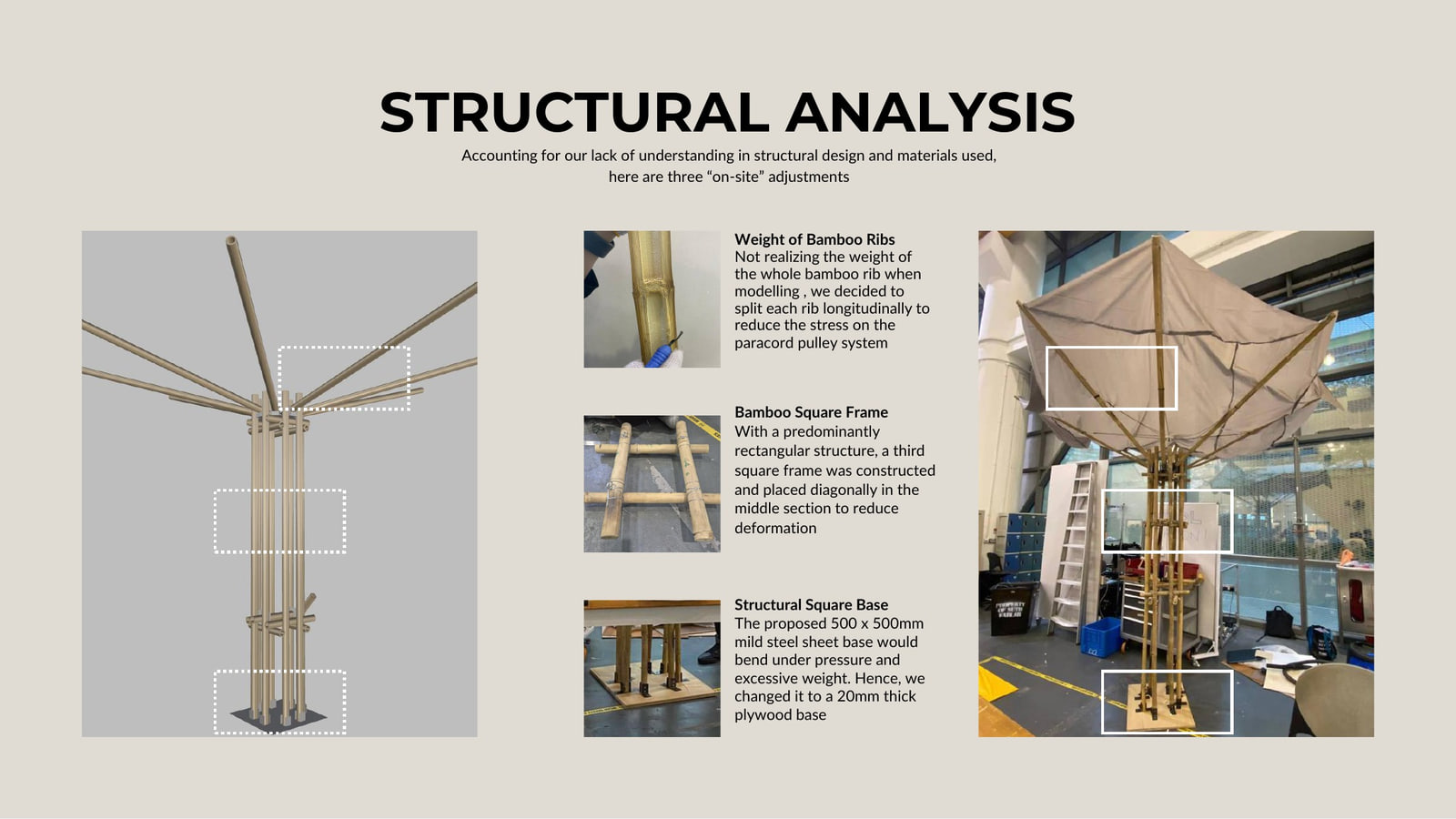
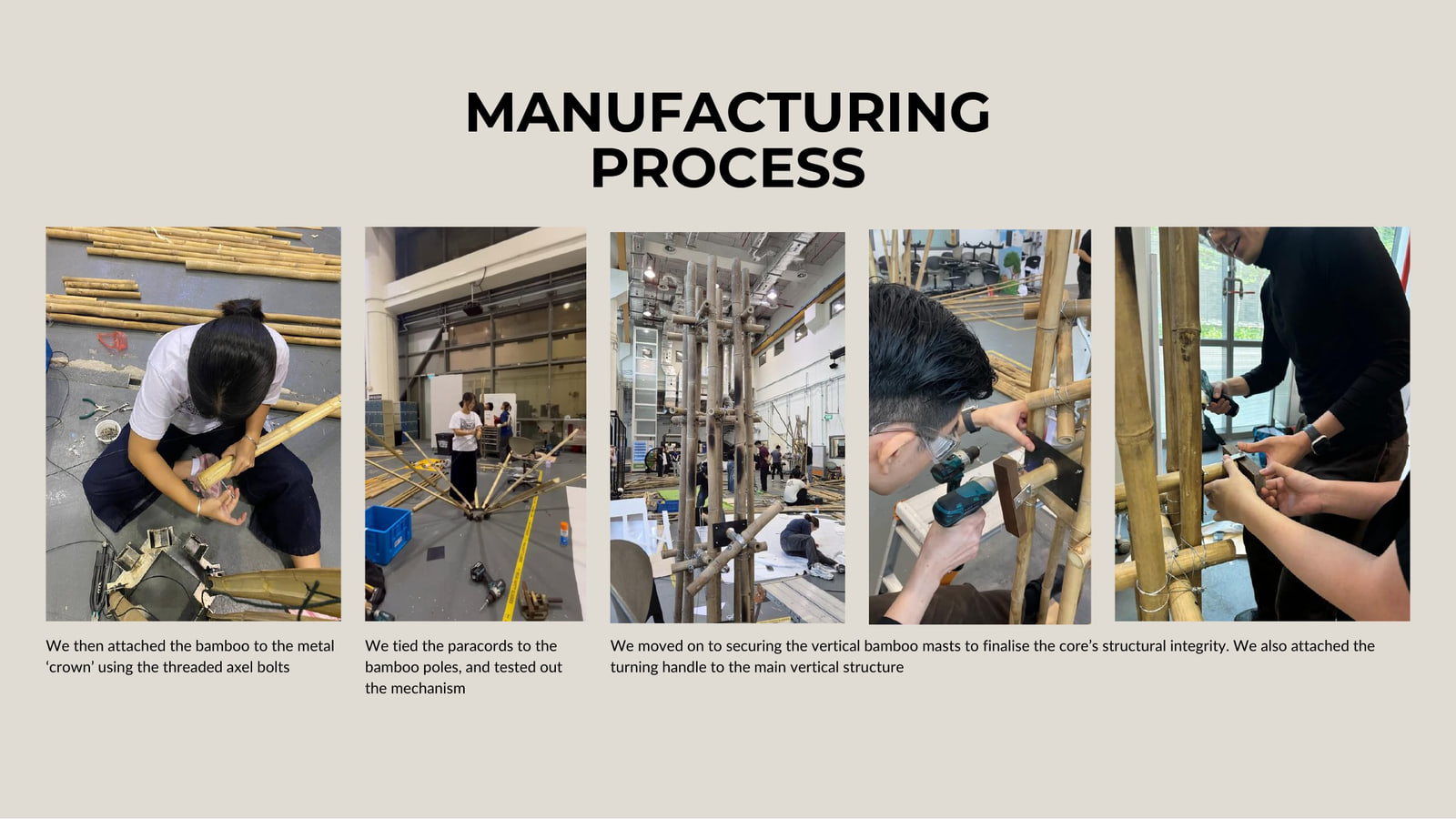
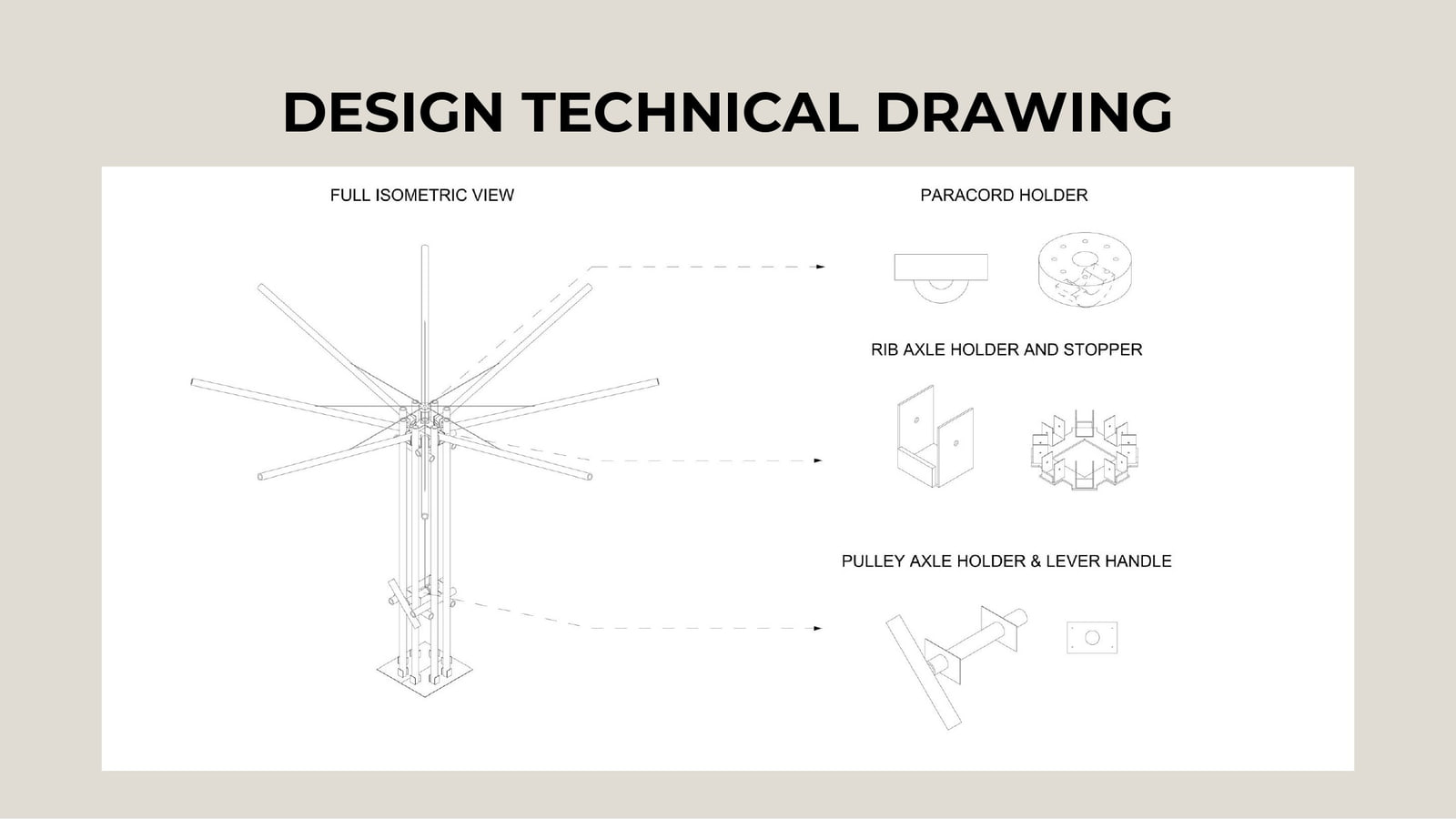
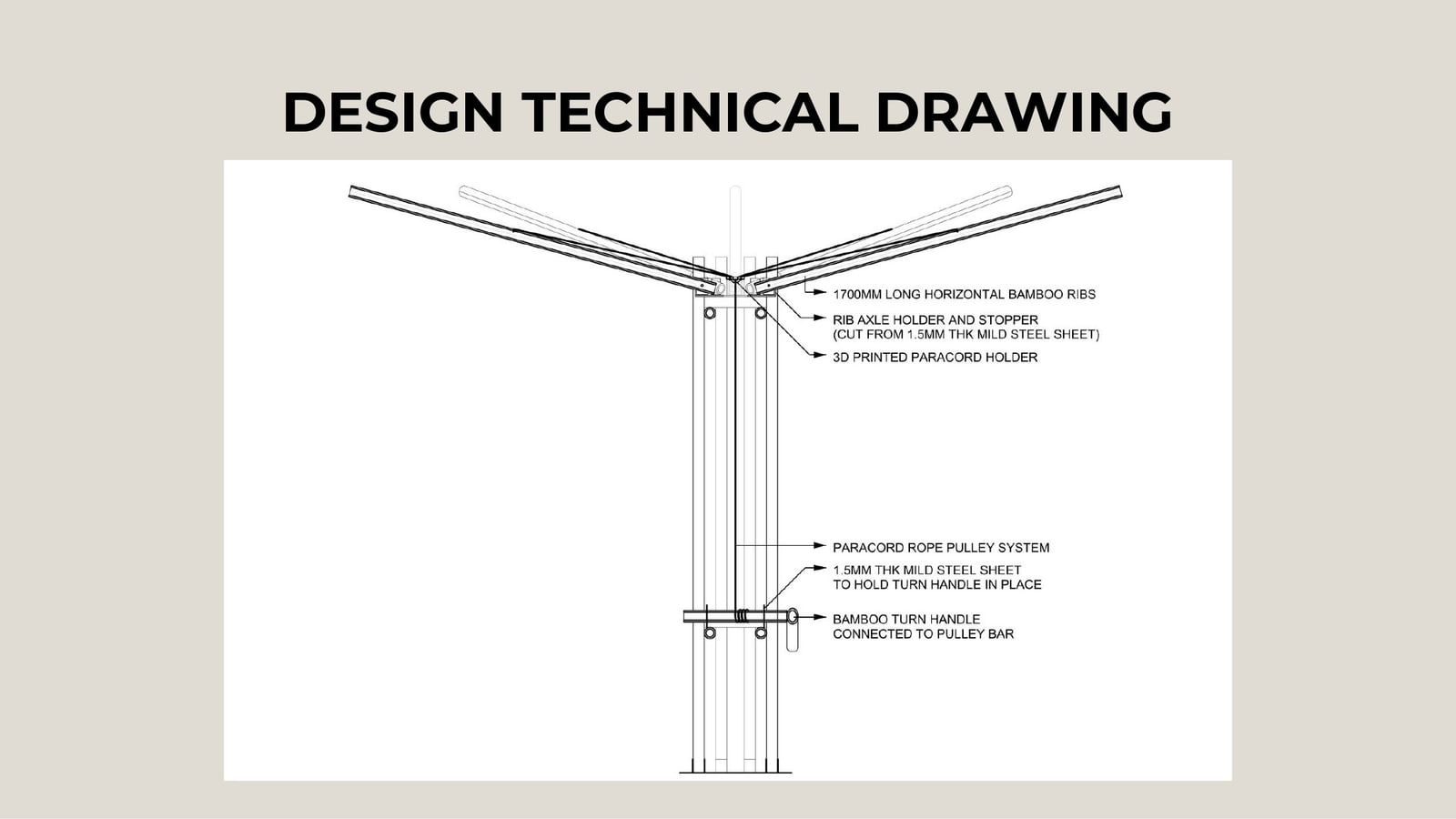
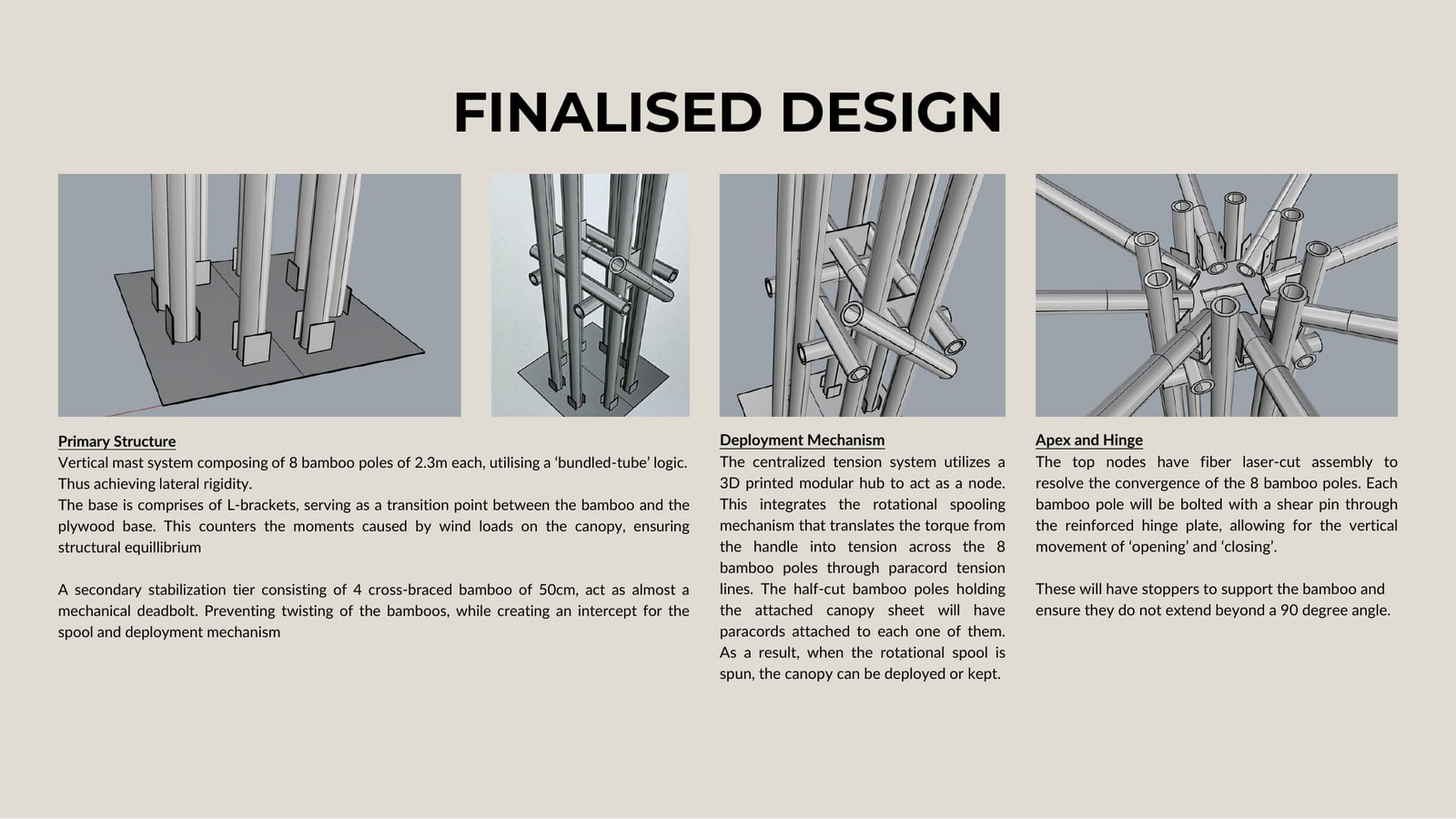
The mast is eight bamboo poles of 2.3 m bundled together, the group's reading of bundled-tube logic, stiffened against torsion by rectilinear bamboo collars lashed on with wire and, late in the build, a third collar set diagonally through the middle bay. L-brackets transfer the mast into a plywood base and resist the moments the canopy collects from wind. At the head, a laser-cut mild steel crown receives eight 1.7 m ribs on shear-pin axles, with stoppers holding the ribs at ninety degrees. Eight paracords run from the ribs down to a 3D-printed hub; a bamboo handle at waist height spools them, converting torque into rib tension. Opened, the canopy spans 3,450 mm.
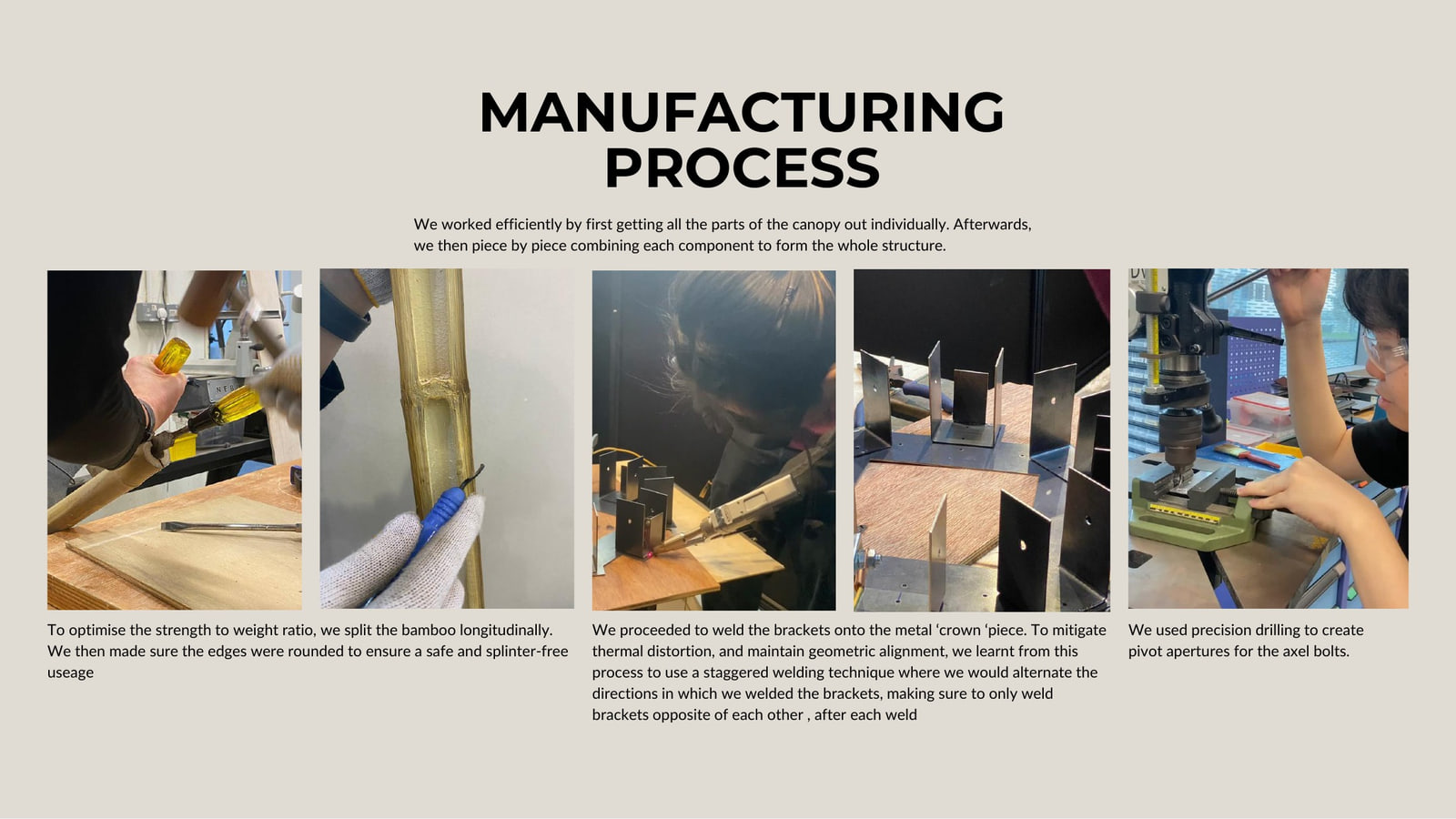
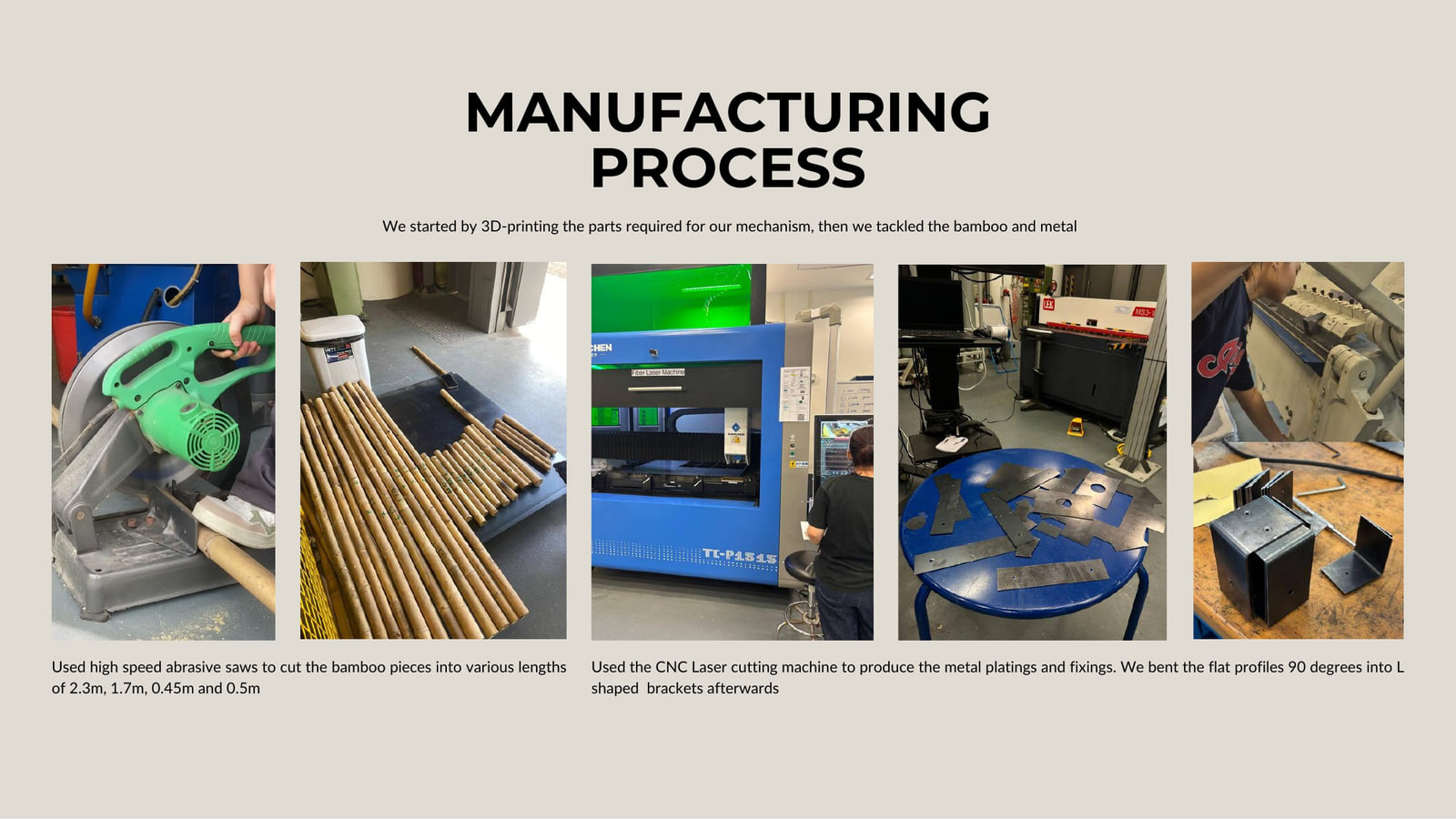
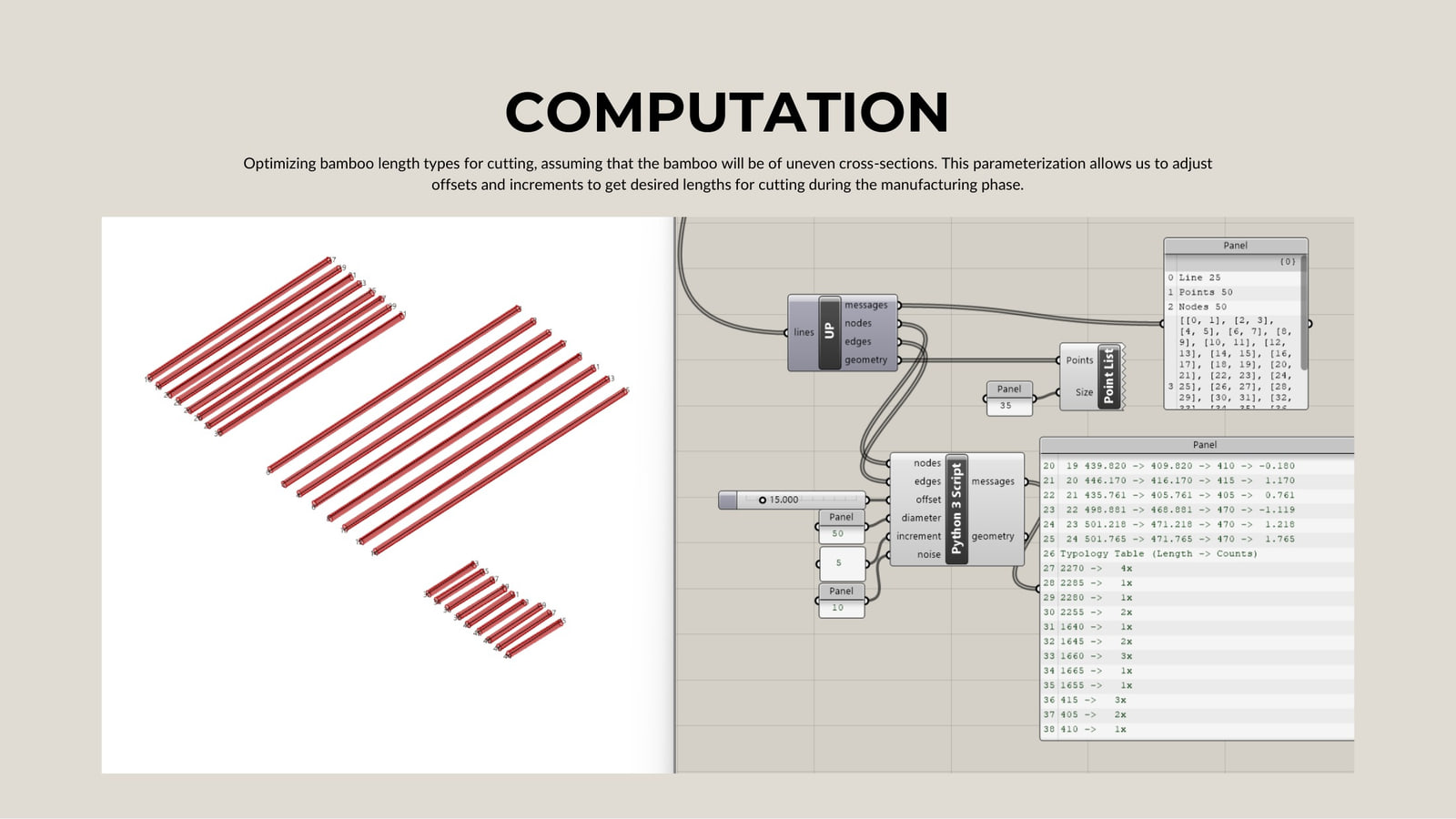
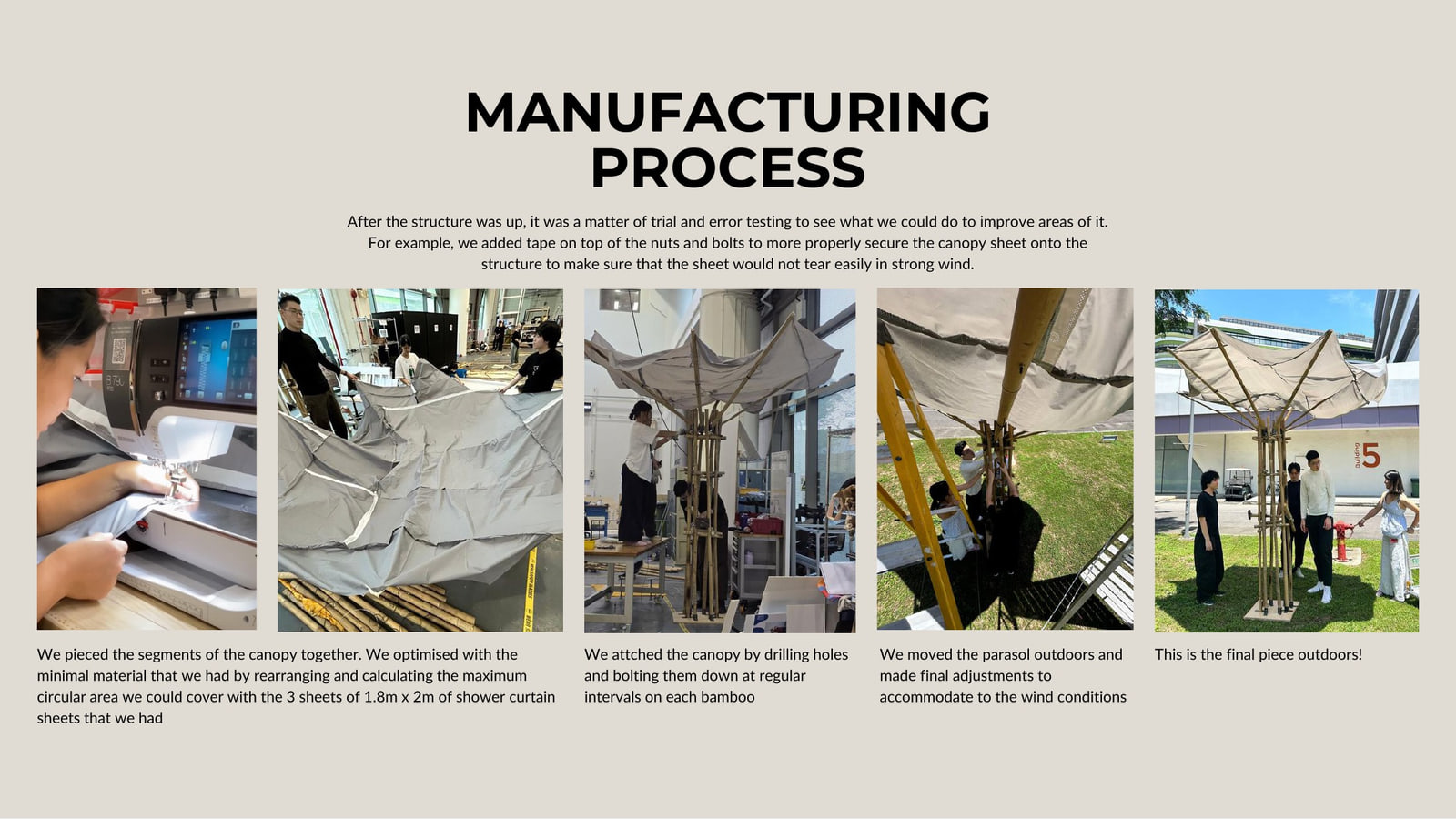
Fabrication ran across the shop's full range. A Grasshopper definition with a Python component parameterised the cutting schedule for bamboo of uneven cross-section, returning a typology table of lengths against counts to drive the abrasive saw. Steel sheet was fibre-laser cut, bent into L-brackets and welded in a staggered sequence — alternating opposite brackets after each pass — to hold geometric alignment against thermal distortion. The ribs were split lengthwise and their edges rounded to cut weight and remove splinters. Three 1.8 × 2 m shower-curtain sheets were recut and sewn together into the largest circular canopy the material would yield.
The submission is candid about what went wrong on site. The ribs were halved only after their weight proved too much for the paracord pulley; the proposed 500 × 500 mm mild steel base bent under load and was replaced with 20 mm plywood; the canopy was never tested outdoors until showcase day, and the sheet had to be taped at each bolt against the wind. The parasol came after two smaller exercises the same term — a lathe-turned ring and a set of vacuum-formed, plaster-cast blocks — which supplied the shop vocabulary it depends on.